A Main Monument Secret: Duomo

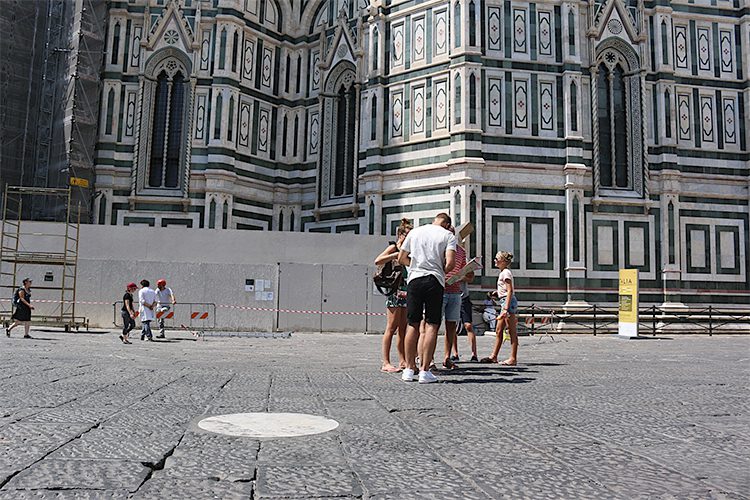
Photo by the author

By Shelby Olson

Throughout my time in Florence, I was not only able to discover the nooks and crannies of the city but make new and at times peculiar discoveries about the large, main monuments everybody knows and loves. I entered what I would call the “tourist phase” and saw anything and everything there was to see but reminiscing on my stay in Florence, I really didn’t know a lot about the places I was visiting. For example, did you know a ball-shaped decoration fell off the Duomo and there is now a marble slab to commemorate it? Me neither.

In January of 1601, Florence experienced a thunderstorm and lightning struck the golden sphere on top of the Dome’s lantern, causing it to detach and land right next to the church. To this day, there is a circular marble slab to signify where the ball landed when it fell off. The sphere, commissioned to Verrocchio in 1468, was made of bronze and weighed almost 2000 kilos (approx. 4409 lbs). Andrea del Verrocchio, it should be mentioned, ended up inheriting the Duomo’s architectural project after Brunelleschi’s death in 1446. The weight itself can show the large impact this ball had upon touchdown. Prior to falling off in 1601 and definitely restored in 1602, the ball had proved be unruly on other occasions – electricity-related problems due to thunderstorms had already been documented at least twice in the 1500s.

Turns out I was not the only one who didn’t know about this “fallen ball.” I decided to visit the Duomo to see the marble slab itself and watch if anybody else would notice it. During my hour of sitting there, not a single person stopped to look at it or take a picture. Rather, I was getting weird looks for taking a picture of this random circle on the ground. This taught me that when you are visiting an important monument, there is so much more to see than its beauty and you should learn everything you can beforehand.

Next time you are visiting the Duomo or simply walking past it, make sure to venture to the back side of the Duomo to check out this marble slab. It may just be a circle on the ground but it holds much significance and you may be one of the few that knows about it. If you learned one thing from this, remember to research the places you are visiting beforehand because you may learn something the tour guide doesn’t tell you.

See more of Florence and Italy at FUA’s FB, Instagram, and Twitter.
The Intricacies of Life in a Renaissance City

duomo-finding-florence-blog-fua

By Leanora Karnath

White marble, red and green lines of color, ornate details covering every inch of its facade, copper ball protruding into the sky. Before arriving for the semester, I knew of Santa Maria del Fiore Cathedral, better known as the Duomo of Florence, but little about its historical or cultural significance within Italy as a European country. My feelings towards one of Florence’s most popular landmarks have evolved throughout my time abroad.

When I first saw the church, I was astounded by its massive size. I strained my neck, scanning the entire length of the front side with hungry eyes. I saw the Duomo in its entirety– the lines of color, the white marble, and the large wooden doors.

After the thrill of the first sighting, I learned that people use the church as a meeting point which frustrated me. Whenever someone said to meet by the Duomo, my body grew tense. Where? I thought. This thing is too big.

I soon became accustomed to walking past the Duomo each day. I hadn’t thought much about the church after my first month abroad other than wishing it wasn’t my usual route to class when flocks of tourists visited, making my route longer than usual.

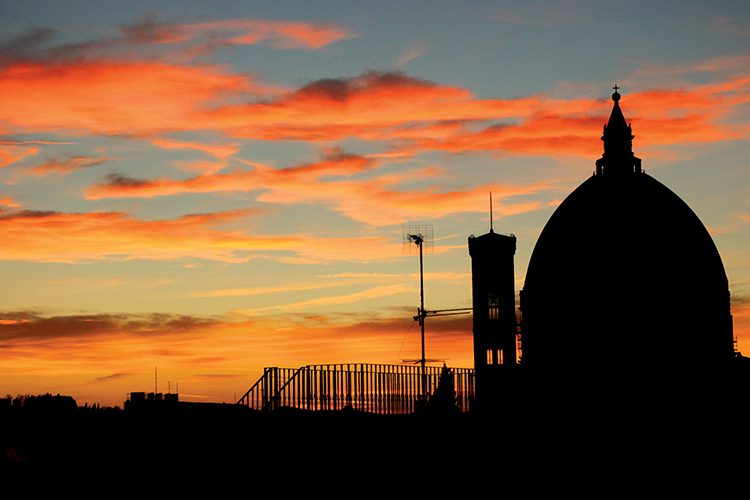
As I stepped away from the Duomo, I realized its functional purpose. When I would become lost around Florence, I simply walked down a few streets and waited to see the Duomo’s copper ball and spherical top. Though I was aware of the Duomo’s presence, I solely viewed it for its practical use.

My indifference began to shift right before my parents’ visit halfway through the semester. Because of my dad’s interest in architecture and history, he read a book about the Duomo before his arrival entitled Brunelleschi’s Dome: How a Renaissance Genius Reinvented Architecture. He asked me, “Did you know they didn’t even use buttresses to support the weight of the Duomo? And that the copper ball fell off in the 1500’s?” I didn’t. I felt ashamed that I had failed to learn much about a monument that stands only five minutes away from my apartment.

As the lines became longer for everything in April, I knew it was time I climbed the Duomo. I purchased my ticket, woke up early on a Wednesday morning, and waited in line. As I began walking up the steep steps, a rush of energy overwhelmed my body. I thought of all the people who did the same hundreds of years ago, the ones who dedicated their lives to create such a beautiful combination of art and architecture to create a place for worship. And, now I was climbing to the top.

Later that same day, I entered the Museo dell’Opera del Duomo and marveled at the displays and the information that accompanied them. It was fascinating to learn about the comprehensive history behind such an influential monument that I was lucky to see on a daily basis. I stepped out of the museum and the Duomo greeted me; my mouth immediately curled into a smile. Wow, I thought.

As I reflect on the semester, I have realized that the Duomo isn’t simply one singular piece of architecture that can be absorbed and processed from one sighting. It’s comprised of many pieces and the tiniest of details: the distinct expressions on the face of numerous statues, the marbled spirals in the windows, the gold streaks of the paintings. I neglected to see all of these intricacies when I first arrived.

These intricacies have not only been present in the Duomo’s structure but also my daily life in Florence: the scent of finocchiona floating in the air as I pass a panino shop, the familiar faces of street musicians, a small piece of colorful street art poking out from the ground.

The church that was once a nuisance to walk around has become a reassuring point of reference, a sign that I had returned home after a long day or weekend of traveling, and a sense of stability in a semester that presented new experiences and challenges each week. During my last few weeks in Florence, I take a little extra time to find a small detail that had previously gone unnoticed. It never fails.

See more of Florence and Italy at FUA’s FB, Instagram, and Twitter.