written & photographed by Kathleen Morris
This blog feature is an exclusive bonus installment to our Spring issue of Blending Magazine. After you finish reading, be sure to explore the rest of the magazine online—just follow this link to download the full Spring 2025 edition:
https://jschoolfua.com/images/BM/BM_151.pdf
How many stories can a single office avocado tell?
As I set my laptop onto Clet Abraham’s cluttered desk, I took inventory of its miscellaneous contents: an avocado, a glass with a solitary drop of red wine left behind and an array of art supplies – pencils, cutting tools and scattered pages filled with cartoonish sketches.
I set my cellphone atop a strip of stickers depicting bright pink sausages, thumb hovering over the record button – ready to capture every bit of wisdom from the infamous street artist who I was face-to-face with at last.
The conversation was highly anticipated. Earlier that morning, after exchanging a flurry of WhatsApp messages with an employee at his Florence studio—including a pointed warning not to address him by his full name, Jean-Marie Clet Abraham—I stepped into the cluttered space – I made the trek across Ponte alle Grazie to his studio on a sun-soaked Monday afternoon.
Tiptoeing down the sidewalk, I realized I didn’t need to consult Google Maps to know I had arrived. I followed a wall plastered in a chaotic assortment of stickers – a street artist’s rendition of the yellow brick road.
My instincts were confirmed by the street sign placed just above the door, reimagined to depict a tiny figure flying through the air, its grip tight on the tip of the white arrow.

The use of street signs has become a trademark of Clet’s art.
Originally from France, Clet has now claimed Florence itself as his canvas.
I first encountered his work by the Medici Palace. With crooked eyes and a corkscrew neck, a portrait of childhood whimsy is plastered onto a traffic sign, its head formed by diverging arrows. In the following days, I began to train my vision to spot Clet’s characters tucked into every corner of this historic city.
My article joins countless attempts to profile the elusive artist, who has earned celebrity status (and over 160k Instagram followers) in a destination that echoes with the voices of the Renaissance.
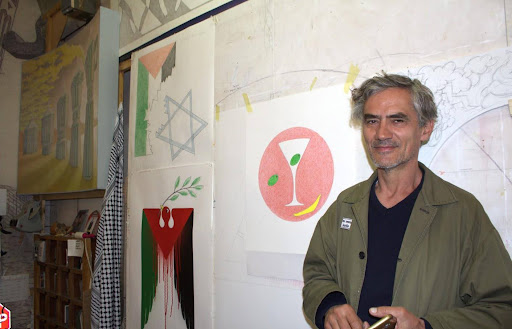
I sought to understand the path of the man who sat across from me, salt-and-pepper hair draped across his forehead and backdropped by a wall of unfinished masterpieces.
The son of creative parents, he recalled his earliest inclination to art.
“When I was young, I used art to be free,” Clet said. “I don’t care about art. I care about freedom.”
Today, his urban installations serve as an outlet for self-expression and a medium for political commentary. With a rebellious flair, he inspires dialogue about pressing social issues and individual rights. Behind his desk, a sign was spray-painted with the colors of the Palestinian flag. The artwork, created in collaboration with the Art for Gaza Collective, exemplifies Clet’s efforts to garner a reaction from and activate the public.
“I don’t think I am the owner of my ideas,” he mused, reflecting on the essence of collaboration he shares with those who engage with his work. “The ideas pass through me,” he said, describing his ability to sculpt messages and inspire his community to think outside the box.

Clet refuses to be confined by artistic boundaries, finding fulfillment in working beyond the walls of traditional museums.
“I don’t work with galleries,” he underscored. “The best place is always the street.”
Clet navigates the gray area between creating impactful art and defacing public spaces. The allure of street art lies in the ambiguity of this ruleless game – a game that Clet has mastered on a global scale, often operating under the cover of night.
“In the United States, I always [install art] at night because I don’t want the police to stop me,” he revealed. “I don’t want to have a big problem and lose my plane ticket to go back home.”
In a perfect world, city authorities would recognize the positive aspects of his work. He imagines that increased acceptance would act like a “business card,” allowing him to explore cities that are “more difficult, where there is less democracy.”
Until then, Clet can be found cloaked in darkness or in the safety of his studio at Via dell’Olmo, 8r in Florence.
Before I exited his sticker-clad oasis, I gathered two pieces of advice from Clet for aspiring artists: embrace your originality, and when working on the streets, it’s best to be a little drunk.

For more information, visit Clet’s website or follow Clet on Instagram (@cletabraham).


