By Amber Wright
Every photograph, video, and snap chat I have ever seen of Cinque Terre has been stunning. The colors of the buildings, the waves breaking on the rocks, and the sun shining down on the tourists makes it the perfect destination, and I finally had the opportunity to experience it for myself.
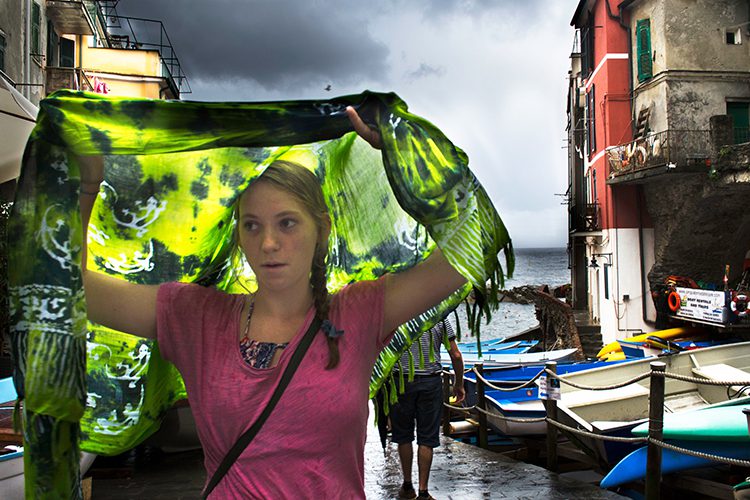
However, the sun wasn’t shining, and the water seemed to be more of a sea monster than just the Mediterranean sea. This area is constantly in danger of mudslides and the hiking trails were closed off for the rain that seemed to never stop falling. My weekend that was supposed to be picturesque and dream-like, now had the potential of being ruined by the Cinque Terre-ible weather.
Thankfully, I was sitting at a covered cafe as the rain came down and was able to just take it all in. I surprisingly loved the rain. I felt that the weather was a nice change from the sweltering heat, and my friends and I were not about to let a few raindrops keep us from the sea. It was surreal swimming in the mediterranean for the first time, during a storm no less, and the view of Monterosso from the water was magnificent. I now understood the raving reviews and why this coastal town deserved to be a protected site.
Sanctioned by the United Nations, a World Heritage Site like Cinque Terre is deemed so for its cultural, scientific, or historical significance. Therefore, it’s unsurprising that Italy, being the beautiful and rich country it is, has the largest number of these UNESCO protected sites.
The symbiotic relationship between man and nature is captured in the complex structure and architecture of each village. The steep hills and cliffs are dotted with buildings and agriculture that have been perfectly constructed to withstand the treacherous coastal area.
Monterosso and Vernazza were the first of the five villages built in the eleventh century. The following three villages were soon developed, and later reinforced with barricades and defence towers to combat the attacks from pirates. By the 15th century, Cinque Terre, or “five villages,” was the local term for the villages, and it was known for it’s excellent vino, produced to this day by incredibly determined farmers whose vines seem to grow vertically from the precipitous inclines. Progress halted in the area when mudslides destroyed the local agriculture, but recovered in the mid-18th century. Fast forward to 1997 when it became a protected area and to 1999 when it was officially named a national park. Today, accessibility is limited in Cinque Terre, and other than a train between the five villages, modern infrastructure has had only a hidden presence in this area.
It’s one of the most photographic areas in Italy, but there is so much more to experience than what you’ll see through the lense of your camera or behind your iPhone. Take a look around and understand why this area is deeply cherished. Look up and see the local old ladies people-watching from above, or take the hike to see the sweeping views from above. Take a dip to feel the warmth of the sea and try your hardest not to swallow the brackish water. Climb the stairs to the top of a watch tower and imagine being under attack by pirates.
Lastly, if the weather is bad, embrace it. Not only did the rain not ruin my trip, but it added to the excitement and memories that I’ll have forever. The history and beauty easily shines through, and I cannot wait to go back.
See more of Florence and Italy at FUA’s FB, Instagram, and Twitter.