By Emelia Imperati
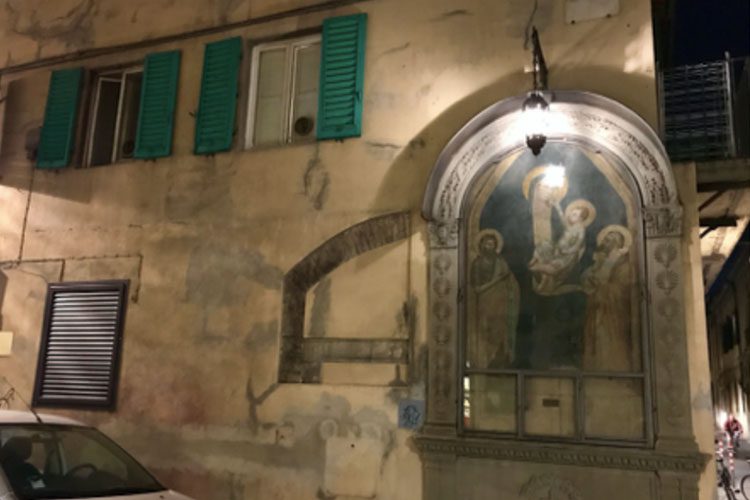
Tabernacles cover the streets of Florence, adding further religious, historical and aesthetic appeal and meaning to the city. Canto di Monteloro is one example of these beautiful and purposeful creations, dedicated to their patron saints.
Although it is customary to be swept away by the grandiose markers of Florence, such as the Duomo or the Santa Croce, many tourists overlook the hidden treasures that flood the city. The Florentine tabernacles cover many streets and offer additional historic and artistic significance that is often overlooked by travelers. Depictions of Pagan gods were originally displayed around the city but were later replaced by images of saints after Constantine’s conversion to Christianity. During the 14th century, Italian towns dedicated themselves to patron saints, and Florence reflected their vowed devotion to the Virgin Mary and John the Baptist through the approximate 1,200 tabernacles. These religious testaments were built to offer support for the Christian doctrine during the war against heresy, during which groups challenged Catholicism. They also were used as a source of protection during the plague in 1348, the year of the “Black Death” Residents utilized them through candle lightings, written prayers, and placed offerings to seek out defense from the patron saints against disease and death. They were commonly commissioned by middle class families, as those of greater wealth focused on assisting cathedrals, chapels, sculptures and more elegant decorations and structures.
One of these tabernacles placed on Via degli Alfani, on the corner of Borgo Pinti, was a common site for these behaviors, customs and beliefs of the past. It was named Canto di Monteloro, meaning Corner of Monteloro. It reflects an illustration of the Virgin Mary holding the child, surrounded by Saint John and Saint Peter. It was built by Compagnia della’Assunta, one of the companies of the Festive Powers, an association of regional companies that created exhibits, parties and banquets. They played an essential role in the construction of antiquities of late Renaissance Florence. The Canto di Monteloro was made with a popular and traditional stone of this era known as pietra serena, which was used for many other structural and artistic creations throughout the city. Below the image of the three saints is a portrayal of a cross on a 3-pointed mountain, which became the crest that gave name to the song the tabernacle was named after, and also to the powerful festive power, Montiloro, who gathered at this location. A wide shed resembling a small chapel originally protected the ornament, but was destroyed by traffic in the street. The fresco underwent several reconstructions overtime and was removed in 1953 for an extended period of time by the Superintendent for Artisitic and Historical Property. It was later replaced in this original location in 1991, and still remains as a beautiful additive to the street.
See more of Florence and Italy at FUA’s FB, Instagram, and Twitter.