Warrior Monks in Medieval Tuscany

Photo by the author

By Jessica Rowe

The abbeys of San Galgano and Sant’Antimo have rich histories that are worth experiencing firsthand. Located outside of Siena, these off-the-beaten-path sites will make you feel like you’ve stepped into a different time.

This summer, students and faculty took a trip to the abbeys of San Galgano and Sant’Antimo on one of FUA’s Educational Field Trips (EFT). The EFT excursions are always well-organized, planned on a student budget, and full of educational information it might be hard to find out on your own. San Galgano and Sant’Antimo were chosen as an EFT location because they are full of historical and cultural significance. Instead of being normal tourist sites students may visit on their own, they are out of the way places that still hold on to a feeling of spirituality. Students are brought to the abbeys to gain a deeper understanding of spirituality and how it can be either connected or disconnected from structured religion.

We met at the Santa Maria Novella train station at 7 a.m. to depart for San Galgano. The trip quickly became unique as instead of heading to a busy city, we were headed out into the countryside. Large fields rolled past, some green and some gold, bringing us further away from the built environment of Florence. When we got to the first stop, our tour started at the Rotunda of Saint Galgano. It holds the tomb of Saint Galgano and the famous sword in the stone. Now, you’re probably thinking, as I was, that King Arthur wasn’t from Italy. But it’s a different sword in the stone with a lesser known tale behind it. As the legend goes, Saint Galgano heard voices calling him to the place where the rotunda now sits and there he saw a vision. He wished to renounce his knighthood so he drove his sword into the stone. For years, people tried to steal the sword but it was said to be guarded by a wolf. Inside the rotunda, the bones of a man who was eaten by the wolf are displayed.

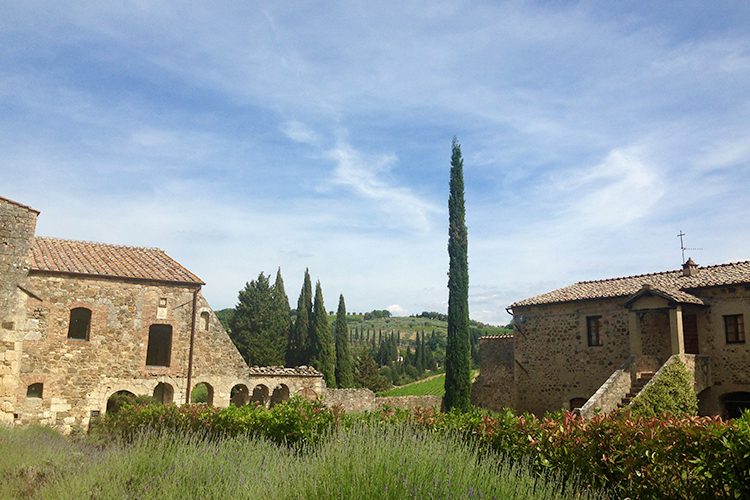
Further out sits the Abbey of San Galgano. It was started in 1218 when the hermitage became too small to contain all the monks and pilgrims. The abbey is built in classic Gothic style and has no roof. It did, at one point, have a roof but the abbey was very poor and resorted to selling the roof piece by piece for money to keep it running. Nowadays, the abbey is funded through ticket sales and event bookings.

We stopped for lunch at Tenuta di Paganico, a local winery, before going on to Sant’Antimo. This abbey was under construction from 1393 until 1526, however it was in 781 that the idea for the abbey was formed. As the story goes, Charlemagne was returning from Rome when most of his court and army caught the plague. The Emperor had a dream where an angel told him to harvest a specific grass, dry it, mix it with some wine, and have his soldiers drink it. When he did so, everyone was cured. He vowed then to build an abbey.

Currently, the abbey houses a group of monks from the Benedictine monastic community of Santa Maria di Monte Oliveto Maggiore. These monks are referred to as Olivetan monks and their order was founded in 1318 by the Sienese Saint Bernardo Tolomei. They go about their days by focusing on prayer, reading and studying, and work. They are known by the white colour of their robes which symbolizes their devotion to the Virgin Mary.

Shelby, a student who attended the trip as an academic field learning activity for her Italian language class, arrived at Sant’Antimo with her group as a service was in progress. After it ended, the class saw all the nuns continue their prayers in the many different spiritual locations inside the abbey. She enjoyed the chance to get a look at what the abbey is currently used for and what it meant to the people who lived there.

After a long day, the trip came to a close and we headed back to Florence. Overall, I had a good time on the trip. I learned a lot about the two abbeys and saw some incredible architecture. I would recommend visiting these two abbeys and the EFT excursions to anyone looking for a fun day trip from Florence.

For more information on EFT trips:

EFT – FUA’s Educational Field Trip Logistics Team
Corso Tintori, 21, Firenze
Phone: 055/244664
E-mail: sld-eft@fua.it

studentlifeflorence.it/educational-field-trips-mission.html

See more of Florence and Italy at FUA’s FB, Instagram, and Twitter.

Florence’s City Walls

Photo by the author

by Jessica Rowe

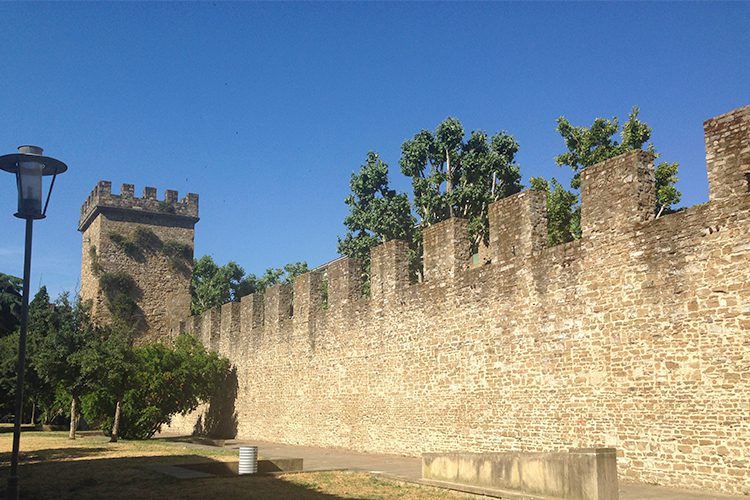
Like most former Roman cities, Florence once had high defensive walls that ran the perimeter of the city. The original gates, some of the towers, and the walls in the Oltrano area remain today as a reminder of the city’s history.

On my first day in Florence, I walked through the city aimlessly and came upon one of the remaining city gates. At the time, I had no idea I was at the Torrino di Santa Rosa. All I knew was that in front of me was a piece of history, the likes of which I would never find in my own city. I looked up in awe at the tower, the gate, and the wall stretching down the length of the road. For the first time, I felt the impact of standing in an ancient city and breathing its history.

Throughout my time here, I’ve been lucky enough to see many of the walls’ remaining parts. Located in the Oltrano area of the city, it is easy to visit the walls today. You can walk beside them with no ticket required. The Torrino di Santa Rosa is right near the river and nearly impossible to miss. You can also visit Porta San Niccolὸ – the only city gate to maintain its original height. For only four euros, you can even climb to the top and look out across the city. Also in the San Niccolò district of the Oltrarno is the Porta San Miniato. Rather than a tower shape, this porta is built as an entrance within city walls that are still standing and the road leading away from the city center connects to the San Miniato al Monte church, hence the name.

I’ve also learned a lot about the walls themselves. Florence was founded around 59 B.C. as the Roman city of Florentia. In the second century, the walls were built out of tradition rather than for defensive purposes. The Roman Empire, at the time, expanded into France and Germany so it would have been rather difficult to attack Florence.

Over the centuries, the walls have been rebuilt, expanded, and restored five times since their original construction. Most of these adjustments were made because of the city’s growing population and the need to keep citizens under military protection. The surviving version of the walls were planned in 1284 but the work didn’t start until 1298. In this iteration, the city gates were set up for the first time and the walls were finally completed in 1333. They stood at 35 metres tall, enclosed 650 hectares of land, and ran a perimeter of 8.5 kilometres.

Then, in 1865, Florence became the capital of Italy for five brief years. However, the city, which had mostly retained its medieval style, had to adjust to the new demands placed on it as capital. Giuseppe Poggi, a Florentine architect and engineer, was commissioned to design an urban renovation of the city. He was chosen for his ability to blend neo-Renaissance style with modern trends. Along with giving the city a wealthy and celebratory look, he was tasked with creating housing and facilities for government employees, and defending the city against a potential flood from the Arno. His ultimate goal was to expand the city limits. He did so by tearing down the old walls and surrounding the city with the Viali di Circonvallazione – a system of large roadways – instead. He left the ancient city gates standing as well as the walls in the Oltrano area.

Knowing all of this, I returned again to the ancient city walls to look upon the years of history in front of me. What started as a Roman tradition had turned into the first line of defense against the siege of Emperor Henry IV and now stood as an ancient artifact, a symbol of the city’s history and its age. In my six weeks here, I have found many signs of Florence’s past and its love for preserving it, but it’s the city walls that call to me. I can hear their stories, walk alongside them and pretend, just for a moment, that they’re here to protect me and the culture of this beautiful city.

Porta San Niccolὸ – Piazza Poggi
June 24 – September 30
Guided tours every 30 minuts from 5 p.m. to 7:30 p.m.
English speaking guides are available.
Tickets: €4
For information/reservations:
Call 055-2768224 or email info@muse.comune.fi.it

See more of Florence and Italy at FUA’s FB, Instagram, and Twitter.

The Library of the Medici

Photo by the author

by Jessica Rowe

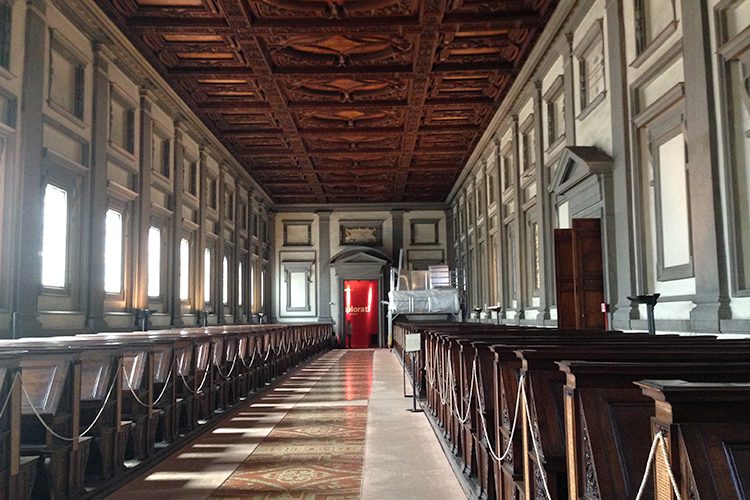
The Laurentian Library is one of Michelangelo’s lesser-known constructions. With its imposing entrance and beautiful stain glass windows, the space houses its treasures in perfect architectural harmony.

The Laurentian Library is part of the San Lorenzo Medicean Complex. Most people visit to see the Medici Chapel, the Basilica’s cellar of treasures, and the Chapel of Princes, where the Medici are buried. They miss the library entirely. But entering the Laurentian Library feels like walking into a work of art. Designed by and constructed under the watchful eye of Michelangelo, the library is considered one of the most unified works of Mannerism in Florence because the decorations were created during the building’s assembly. The grand staircase leads into a reading room filled with pews and stained glass windows.

The library is a cultural inheritance from the Medici family. The collection was started by Cosimo the Elder and his friend Niccolò Niccoli. The two of them shared a desire to collect ancient manuscripts and, when Niccoli died, he left his collection to Cosimo.

In 1494, the Medici family was banished from Florence and Cosimo’s collection was confiscated by the republican government to be added to the San Marco monastery’s library. The collection was later moved to Rome before returning to Florence once again in 1523. It was then that Michelangelo was commissioned to build a library to house the collection. The library was meant to signal that the Medici were no longer merchants but now members of the church and intelligent society. In 1571, still incomplete, the library was opened to scholars.

There are many architectural aspects of the building that break the rules of ancient architectural theory. For one, it is impossible to tell if the walls or the columns hold up the ceiling as the columns are imbedded in the walls themselves. Also, the staircase leading into the library is often said to seem too big for the space. Since proportions were very important to Renaissance architecture, historians believe that these stairs are the first sign that Michelangelo had intentionally turned away from tradition. The space allocated for the library was also limited before construction started as the monastic complex was already built. Still, the entrance vestibule, or ricetto, appears to mimic the human body, resembling skin pulled tight between vertical supports, which was believed to be the ideal form during the Renaissance.

Today, the Laurentian Library is considered the most important and prestigious collection of antique books in Italy. It contains more than 11 000 manuscripts and 4 500 early printed books, including the Codex Amiatinus which contains the earliest surviving manuscript of the Latin Vulgate Bible and fragments of the Erinna papyrus which contains poems of Sappho’s friend.

Laurentian Medici Library
Piazza San Lorenzo n° 9 – 50123 Firenze
Tesori inesplorati Exhibit
Open 15 February – 23 June 2017
Monday – Friday | 9.30 a.m. – 1.30 p.m.
www.bmlonline.it/en

See more of Florence at FUA’s FB, Instagram, and Twitter.
Museo 900: Exploring 20th Cent. Art in Florence

Photo by the author

by Jessica Rowe

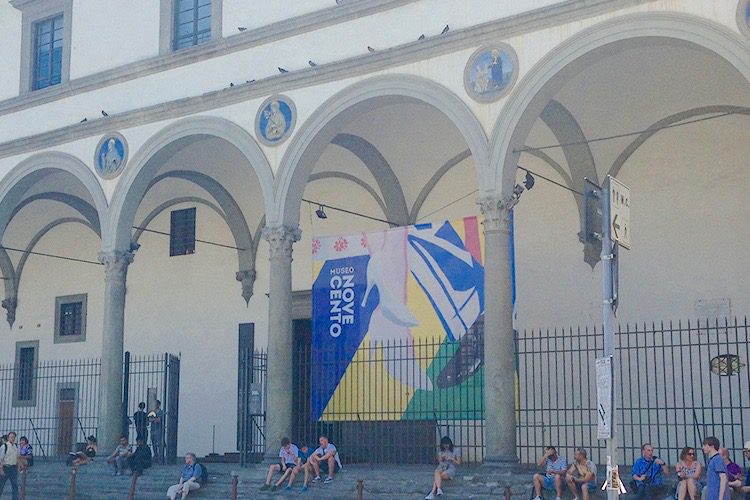
The Museo Novecento is a 20th century Italian art museum in Florence. While we tend to focus on the Uffizi and Galleria dell’Academia, it is just as important to appreciate the work of modern artists.

Recently, I had the chance to visit the Museo Novecento in Florence. In a city full of historic art, this museum, which focuses on 20th century Italian art, is often overlooked. While the older works are widely known and beautiful, it is important to consider more modern contributions and movements in art.

Art in the 20th century was greatly influenced by the events of the time. Known mainly for the rise of modernism – a movement to revitalize the way society saw art – the 20th century brought with it expressions of nihilism and art so abstract as to make the viewer question what really counted as art. At the same time, this period marked a break from the past. Artists wished to move forward and acknowledge contemporary work instead of just that of the greats.

In 1945, Arturo Martini published an essay entitled “Sculpture: A Dead Language” which incited a new generation of artists to push back through the 1950s and 60s. This response included sculptures made out of new and odd materials, such as various types of metal. These sculptures also explored uglier sides of life and the perspective of the artist instead of displaying a perfect subject. This matched the feeling of the time as young people were beginning to separate from their parents’ ideals and values in order to make up their own minds.

The century progressed with the creation of Gruppo 70 in 1963, an artists’ group that focused on the meshing of language with visuals. They did this in order to analyze how advertisements and propaganda affected people. These artists wanted to take back the medium, to figure out how it worked in order to be less affected by it themselves and to effect others with the meaning of their own works. At this time the political atmosphere was split due to the Cold War so it is easy to understand why artists would try to find their own voices outside the influence of the government.

Groups like this gave way to movements that tried to get new, contemporary artists on the scene. From 1964 until 1974, the municipality of Florence had a bursary to help young artists pursue their studies. It granted one million lire each to four students – two in painting and two in sculpture. This inspired new work in the 20th century and new voices. It also gave a place for young artists to compete and show off their work.

During this time, in November 1966, Florence flooded and hundreds of ancient works of art were damaged. So called “mud angels” worked to restore the works but out of this came the 1967 “Artists for Florence” exhibition, which focused on contemporary work and its importance to society. This further shows contemporaries trying to pull away from the past and make names for themselves. The desire to do this is what made the 20th century a period of change and originality.

20th century art has greatly influenced the art that we see today. Many new techniques and styles were born in this period and continue to be used today. Artists now have much more room to grow and explore their own ideas than they did before modernism. While the greats will always have a place in art history, it was the 20th century that allowed contemporaries to find their own voices and branch out from what others had done in the past.

Museo Novecento
Complesso dello Spedale delle Leopoldine – P. Santa Maria Novella 10, FirenzeSummer opening hours (1st of April – 30th of September)
Mon – Tue – Wed – Sat – Sun | 11.00am – 8.00pm
Thursday | 11.00am – 2.00 pm
Friday | 11.00am – 11.00 pm
The last entry is one hour before closing.
www.museonovecento.it/en/

See more of Florence at FUA’s FBInstagram, and Twitter.

Fashion Innovation: 9 Decades of Gucci

By Lauren Miller
Photo by Jordyn Asakowicz

The innovation theme of our latest magazine continues with our radio podcasts. How did Gucci gain its sudden ascent in the fashion world in the past few seasons? Lauren Miller investigates the evolution of Gucci’s history and the brand’s new creative director Alessandro Michele who has all the editors and influencers buzzing about his collections.

Music courtesy by FUA Music Production Course students:
Mason Bikshorn, John Filippo
“The Jazz Age 1920s”
“Soundscape of World War II,” standard Youtube License.
“Wipeout” by The Beach Boys

Magliabechi: An Unsung Hero

Photo by the author

by Jessica Rowe

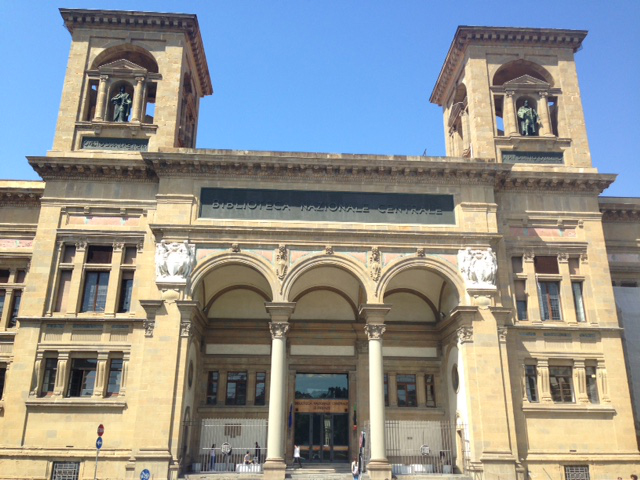
FUA’s DIVA building sits on via Magliabechi, a street named for a lesser-known Florentine hero: Antonio Magliabechi, a man instrumental to the creation of the public library in Florence.

Antonio Magliabechi is a man who many people new to Florence may have never heard of but his influence can still be felt throughout the city today. He was instrumental in the creation of the first public library in Florence and dedicated his life to books and reading. He was a librarian, a scholar, and a bibliophile. Because of him, it is easier for people to access knowledge and learn to read, creating a better educated society for us all.

Born in 1633, Magliabechi apprenticed as a goldsmith and worked as such until he was forty. It wasn’t until Michele Ermini took an interest in him that he learned Latin, Greek, and Hebrew. In 1673, he became the librarian to Cosimo III de’Medici, the Grand Duke of Tuscany.

Magliabechi was well-known for his love of books and his incredible ability to retain knowledge. He owned forty-thousand books and ten thousand manuscripts and had read all of them. His house overflowed with books, so much so that even the porch was covered with them. Scholars and authors from every nation corresponded with him and, while he never wrote himself, he was more than happy to help out writers. As a result, he had many books dedicated to him.

Magliabechi was also known for being incredibly eccentric. He often ignored the realities of life in order to continue reading. This led to such things as him not drawing his salary, wearing clothes until they fell off of him, and not undressing before going to bed. He only left Florence twice in his life and the furthest he went was to Prato, where he accompanied Cardinal Henry Norris, the Vatican librarian, to see a manuscript.

When he died in 1714, he left his books to be used as a public library and, in 1861, his collection was combined with that of Victor Emanuel II, the King of Italy, to form the core collection of the Biblioteca Nazionale Centrale Firenze. Today, this library sits on the corner of via Magliabechi and via Tripoli, which is a continuation of Corso dei Tintori where FUA’s main campus is located.

See more of Florence at FUA’s FBInstagram, and Twitter.

Unraveling Street Names: Via vs. Borgo

Photo by the author

by Jessica Rowe

As you walk through Florence, you’ll see that street names usually start with via or borgo. What do these words means? What are the differences between the streets? It’s quite simple, really.

If you’ve been walking around the streets of Florence, you might have realized that different street names have different words in front of them – usually via or borgo. If you don’t know Italian, then telling the difference between these two types of streets is nearly impossible.

To start, we can define the words “via” and “borgo.” Via (pl. vie) typically means “street.” Borgo (pl. borghi), on the other hand, translates to “village.” From this we would assume that borghi would be bigger streets, perhaps with more apartment buildings or houses, and that they would more closely resemble little towns of their own rather than streets. However, these assumptions would be wrong.

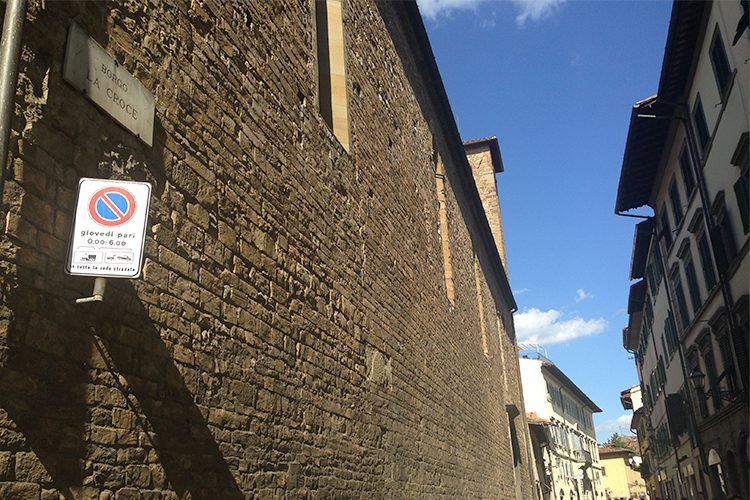
While trying to figure this out, I walked down Via Pietrapiana which later turns into Borgo la Croce. I thought that the difference between these two types of streets would hit me when I crossed from one to the other. In truth, I didn’t even notice the street had switched names until I was a full block down Borgo la Croce. I then started to pay more attention. The contents of the streets were similar – shops, apartments, restaurants, etc. – and the number of each was nearly the same. However, Borgo la Croce is a narrower street with much less traffic. People walk right down the street and barely ever have to move out of the way for cars or motorcycles. Via Pietrapiana, on the other hand, had much more traffic on it.

From this, I concluded that borghi were streets with less traffic that were more accommodating for pedestrians. This, unfortunately, did not hold true for every borgo I passed. Some of them had heavy traffic and even parking on the street. The only difference that seemed fairly uniform was that borghi were almost always narrower than vie.

To figure this out, I contacted Catia Ballerini who works at FUA’s Squola. She said that in normal usage the two words are just different ways to say “street,” like avenue or road in English. However, she also found out that borgo was used to name medieval streets of varying size. The use of borgo indicated that the neighbourhood was located outside of the city’s defensive walls but as the city expanded, these streets became included in the historic centre. Via, on the other hand, was used to name any city space used for traffic.

In conclusion, we see that nowadays via and borgo can be used interchangeably but, in the past, these two words indicated the locations of roads in reference to the city walls.

See more of Florence at FUA’s FBInstagram, and Twitter.

The Best Places to Draw in Florence

Photo by the author

By Jessica Rowe

We all know that Florence is a beautiful city filled with incredible sites. If you’re an artist, you might feel at a loss for where to begin drawing the scenery – fear not, we’re here to help!

Florence’s beauty deserves to be captured in art by hands of all levels, from the very professional to hobbyists. However, in a city so full of phenomenal views, it might be hard to know where to start sketching. Here is a short list of some of the best places in the city to settle down and break out your sketchbook:

  1. Piazza Massimo D’Azeglio – This piazza is a beautiful park full of leafy green trees, stone paths, benches, and a playground. There are plenty of places to sit down and relax. The environment is perfect for doing some drawings and you’ll have plenty of subjects to choose from – the greenery, the park itself, or even the surrounding buildings which have intricate stonework on their exteriors.
  2. Piazza Santa Croce – The Basilica of Santa Croce is the perfect subject for your sketchbook. Besides being breath-taking, the details on its exterior will give you plenty of practice at fine-tuning your drawing skills. There aren’t many places to sit around the building – it may be easier to find a place to sit in one of the surrounding restaurants – but the view is worth it.
  3. Lungarno delle Grazie/Ponte alle Grazie – The Lungarno della Grazie runs along the river Arno, giving you a beautiful view of the other half of the city. There are cafes here that you can sit at and look out the windows while you draw. If you go out on the Ponte alla Grazie, you’ll have an amazing view of the Ponte Vecchio. There is nowhere to sit but if you’re careful, you can lean against the railing while sketching.
  4. Piazza della Repubblica – At night, this piazza is the most beautiful place to be. In the center sits a carousel ringed with lights and street performers dance and sing nearby. Around the piazza there are nice restaurants and at its back is the wall marking the center of the city. It’s always buzzing with people and movement. There are plenty of places to sit and sketch this beautiful scene.

There are, of course, many additional beautiful places to sketch in Florence, but this list is meant to give you a place to start. Find more incredible views on your own and fill your sketchbook with the sights of Florence.

See more of Florence at FUA’s FBInstagram, and Twitter.

The History of Via Sant’Egidio

Photo by the author

By Jessica Rowe

Via Sant’Egidio is a small street in Florence with a long history. On this street, you’ll find the Hospital of Santa Maria Nuova and, inside, the church that gave the street its name.

Via Sant’Egidio is a small, quaint street nestled between Via Bufalini and Piazza Gaetano Salvemini. Along this street you will find a mixture of shops and apartment buildings, often with bars on the windows or green shutters.

What you might not know when walking down this street is that it’s named after the Sant’Egidio church which currently resides inside the Hospital of Santa Maria Nuova. The church was rebuilt from its ancient foundation and consecrated by Pope Martin V in 1419. During the 16th, 17th, and 18th centuries, the church was restored and changes were made to it.

Sant’Egidio is the Italian name for St. Giles, a Christian saint and the patron saint of many things, including beggars, epilepsy, forests, and fertility.

This street is almost perfectly centered in the nexus of FUA’s buildings. You may even walk down it without realizing it as you go from Ganzo to Squola. But even if you miss most of the street, you cannot miss the hospital. The building takes up much of the street and the exterior is laced with beautiful details. There is a plaque by one of the doors that tells you about the church and its history.

You can visit the church for free from 8-12 a.m. or from 4-6 p.m. While the original art from the church has been lost, the art currently inside is well worth a look.

See more of Florence at FUA’s 
FBInstagram, and Twitter.

June Events in Florence

As temperatures start to heat up and Italians head toward the beaches, the month of June proves to be busy in and around Florence. From music festivals to historical soccer matches and medieval dinners, tourists and Florentines alike are sure not to get bored with these upcoming events. Here are some suggestions that FUA students put together.

Il Mercatale

By Jessica Kruebbe

Piazza della Repubblica will host another one of its Mercatale events for the public. The market is normally held the first weekend of each month welcoming residents and tourists alike. The next market will be held on June 3rd and 4th from 8:30 to 19:30. There will be 84 producers at the event, 46 of which are from the province of Florence. Others are from the surrounding provinces such as Prato, Siena, and Arezzo. Visitors can browse long booths full of wine, oil, vegetables, fruit, truffles, and other freshly grown produce. In addition, there will be some typical products from the area including salami, cheese, and honey. The variety of vendors allows passersby to try many authentic foods such as “necci” biscuits of the Tuscan Appennino. For the rest of the spring and summer seasons, the market will rotate between Piazza Repubblica, Piazza del Carmine, and Piazza Santa Maria Novella.

A Cena da Messer Giovanni

By Whitney Byrd

Hear ye, hear ye!
Come experience a night in Medieval times sponsored by the Municipality of Certaldo on June 10th and June 17th. Join us in the beautiful castle in Certaldo Alto, the small medieval town, for the 17th annual feast!
The night will consist of a typical dinner from Medieval times served with authentic wooden cutlery. The menu for both evenings will be the same, catered by Party Giò-Certaldo. The meal will be served by 80 boys and girls in medieval costumes.
No feast would be complete without entertainment! Between courses, don’t miss the sword duels, fire eaters, and a performance by Compagnia del Drago Nero. To celebrate the end of the evening, stick around for a magnificent fireworks display over Palazzo Petrorio!

“A Cena da Messer Giovanni” will begin at 20:00 and end at 23:00.
Don’t forget to book in advance! Cost is € 39 / person

For reservations:
Grazia Palmieri, Via 2 Giugno – Certaldo (FI)
Tel. 0571 663128 – Cell. 335 6988480
info@elitropia.org

Rock the House Down with Firenze Rocks Summer Festival!

By Paige Petronio

Florence Italy- From June 23rd until the 25th at the Visarno Arena big names like Aerosmith, The Cranberries, and Placebo will be sharing their talent to the people of Florence. They are expecting big crowds for this event and the Mayer of Florence has already stated that for those three days Florence is going to be the “capital of rock”.

This festival is bringing in talent from all over the world. This includes English chart topping bands making their first Italian Debut along with some lesser known acts including Prophets of Rage and Glen Hansard. Accompanying these amazing artists, will be a variety of food trucks and stands to cater to the concert goers cravings.

The festival has even created its own app available that you can download so that you can stay in touch with all of the exclusive content throughout the entire festival. This gives guests the ability to take pictures with exclusive filters. Most importantly it will have a lay out of each of the acts so you can be sure to not miss your favorite singers.

What: Firenze Rocks!
Who: Big names including Aerosmith, Eddie Vedder and System of a Down
Where: Visarno Arena
When: June 23, 24, 25, 2017
The summer Firenze Rocks tickets are on sale online: www.ticketone.it

La Festa di San Giovanni

By Lauren Fulton

The summer months of Florence showcase beautiful blue skies and sparkling water as the temperatures increase in the lovely summer months of Italy. June 24 brings lots of excitement and cheer to the city as Florence celebrates their patron saint, Saint John the Baptist. Throughout the day festivities can be discovered around the city. The main event of the day, is the final game of Calcio Storico, a soccer game mixed with some rugby and wrestling played in historic Renaissance attire, followed by fireworks at the end of the night. Calcio Storico includes four teams, representing the four historical neighborhoods of Firenze. The semifinals begin the weekend of June 11, times to be announced.

See more of Florence at FUA’s FBInstagram, and Twitter.