Inside the Tuscan Butcher Shop Where Tradition, Ethics, and Culinary Art Collide
written by Connor McHugh for SPEL Journalism
In the heart of Tuscany lies the small town of Panzano, where there is a butcher shop with a man dubbed “The Greatest Butcher Who Ever Lived.” Dario Cecchini has taken the occupation of being a butcher and turned it into an art form. Armed with a brass instrument that signals the opening of the shop each morning, Cecchini has become an icon in the world of food and animal rights.
While born into an eighth-generation family, Cecchini was originally never interested in the life of a butcher. He grew so attached to the cattle they raised that he moved to Pisa to become a veterinarian. After the early death of his father, Cecchini was forced to return to Panzano to take over the family business. Cecchini saw this as an opportunity to change the butcher world and its treatment of animals. He instituted non-negotiable rules for every cow that he used. These included the cattle living a full and happy life, only using free-range cattle, and requiring the use of every part of the animal. This ensured the best possible life for every animal used and that no death was in vain.
This unique and innovative approach to his craft has led him to collaborate with the likes of Anthony Bourdain, Jamie Oliver, and Gordon Ramsay. He has appeared on shows such as Chef’s Table on Netflix, where he uses his platform to advocate for the lives of animals that are used in cooking. Cecchini gained international attention when, in 2001, he held a televised mock funeral for cows after the EU banned the sale of beef on the bone, which caused meat producers to waste large amounts of beef. The funeral made waves around the culinary world and caused many butchers to follow in his footsteps by using the “head to tail” approach. The “head to tail” approach is a method that uses every single part of the cow, all they way from the head to the tail.
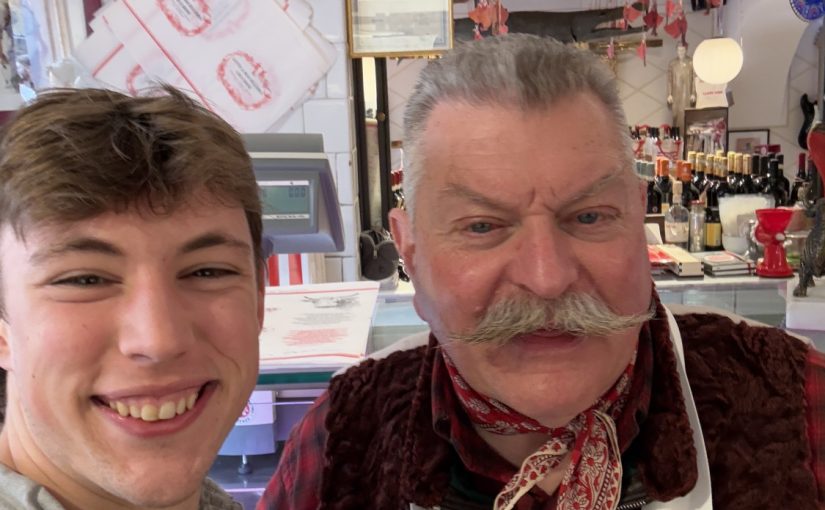
I had the opportunity to visit Antica Macelleria Cecchini during a wine tour to see for myself the amazing food that the best butcher alive can make. When I first arrived, the shop was surrounded by people waiting for the store to open. A few minutes later, Cecchini came out with his signature small trumpet and played a tune along with his famous “Carne Diem” chants to welcome the guests and signal the official opening of the macelleria.
As guests ushered into the macelleria, they were greeted with bread topped with solidified beef tallow, which comes from the fat of the cow. From the moment you walk in, Cecchini stays true to his goal of using every part of an animal to honor it. As most producers would throw away this part of the animal completely, Cecchini turns it into a savory starter that leaves the customer wanting more.
Heading down to the reserved table for our tour group, the table was set for a family-style dinner with a pre-made menu. The restaurant employs mainly special needs workers, as Cecchini wants to provide opportunities for work to a highly marginalized community in Italy. A message on the placemat informs guests that this is a special type of butcher shop, so you won’t find only traditional cuts of meat but rather any part of the cow that you could want. The restaurant also intentionally seats you at the same table with people not from your party to create a community around the food. My table had people from Texas, Minnesota, England, and Hong Kong. It was a new experience but one that truly did elevate the meal because of the chance to eat with people from all over the world.
Next came the meat. A lot of meat. The meat was flying around the table so fast it was hard to keep up. They brought out multiple dishes, family style, for people to take a little from each plate and pass it around. The objective was to taste the dish and try to guess what part of the cow it came from. Typically, the most common cuts of meat are taken from the loin and the rib. All of the beef that we were served was taken from the typically unused parts in traditional restaurants. There were parts from the neck, round, shank, and brain. These parts usually are not as fatty and more muscular, so they don’t inherently contain as much flavor.
I had high expectations because of the reputation the place… and Cecchini delivered. My expectations were shattered. If you told me that I was eating a $300 steak, I would have believed you. The craftsmanship required to turn “useless” parts of a cow into a high-end delicacy cannot go understated. It is a testament to decades of learning and loving an animal so much that you want to honor it, even in death.
As I left Antica Macelleria Cecchini, I couldn’t help but reflect on the experience—not just the meal, but the philosophy behind it. Dario Cecchini is more than a butcher; he is a storyteller, a craftsman, and a guardian of tradition. His passion for honoring animals, his commitment to ethical butchery, and his ability to turn forgotten cuts into culinary masterpieces make him a true icon in the food world. In a time when mass production often overshadows quality and care, Cecchini’s work is a reminder that food should be respected, shared, and, above all, celebrated.