 Photo by author
By Samantha Bedell
Samantha Bedell shares her experiences of visiting an Esselunga supermarket in Florence and the exhibition Esselunga Supermostra. Esselunga Supermostra details the rich history of the supermarket chain throughout the last sixty years.
Esselunga has been a part of Italian culture for sixty years. First established in Milan in 1957, and later introduced in Florence a few years later, this supermarket chain has been at the center of Italian culture since its inception.
Esselunga on Via Masaccio in Florence is reminiscent of a typical supermarket. There are aisles of products like one may expect, but the charm of Esselunga is in the details. Looking up there are products hanging overhead that don’t necessarily correspond to the aisles below. For example, an aisle may have boxed cookies, but above are slippers in a plethora of sizes. Turning a corner, one may expect a display with fruits or vegetables, but in Esselunga there could be a display of popular novels. To understand Esselunga’s uniqueness, there needs to be a look back in time.
To celebrate Esselunga’s sixtieth anniversary, there is an exhibition titled Esselunga Supermostra at Stazione Leopolda. I will fully admit, I did not know what to expect at an exhibition about a supermarket chain.
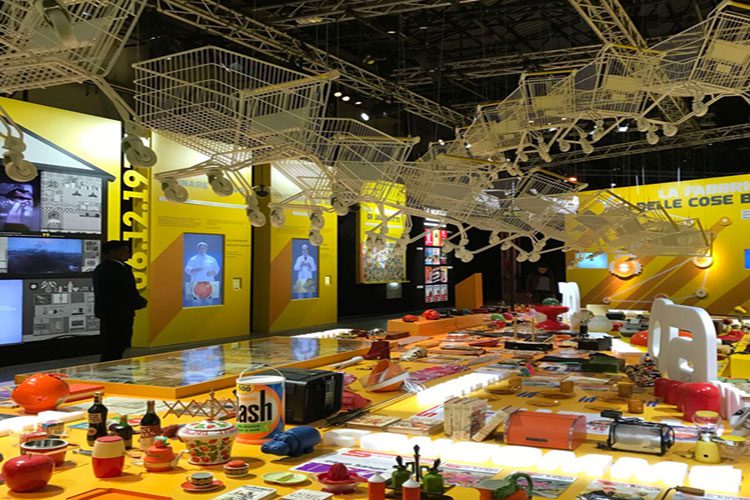
Walking to the exhibition, you’re greeted by large iron gates and banners detailing the dates of the show. Security opens the door for visitors to enter and a few rows of cash registers from the fifties transports you back in time. Through a sweeping black curtain is another wall replicated to look as if it were the original 1957 entrance to an Esselunga. Once through the fringe, the visitor is taken back to the sixties and seventies. The walls are a bright yellow and the ceiling has a sculpture of grocery carts that lead the eye from one end of the room to the other. Below the sculpture is a large platform full of products Esselunga would have sold at the time and other items that were culturally relevant. Most of the walls are interactive to engage visitors of any age. One wall details where Esselunga has imported its products from while another lets visitors discover different recipes used by the supermarket.
The next room highlights the architecture of Esselunga and the eighties. The architecture of the chain is described in a series of models, watercolor paintings, and photographs. On a large yellow wall hangs items that are quintessential of the time like leg warmers, Rubik’s cubes, and Walkmans. At the center of the room is a “behind the scenes” of an Esselunga warehouse and a small dance floor complete with a disco ball, lights, and music.
The following room highlights the ad campaigns in the mid nineties. I have never seen a similar campaign full of whimsy. Each sculpture and poster in this room relies on taking the product it is featuring and turning it into something else. For example, one poster asks “mappamondo o melone?” and the image is of a honeydew melon shaped as if it were a globe. There are dozens of ads similar to this throughout the room, and each has the ability to make the viewer smile.
The next section of the exhibit stands out the most. Mirrors cover the ceiling and floor to mimic a kaleidoscope while a video plays on the walls. The videos that play take the visitor from the beginning to end of the production of some of Esselunga’s products like pasta and desserts.
The final room of Esselunga Supermostra wraps up the visitor’s experience by declaring the chain’s continued support for the arts and always providing convenience and the lowest prices for their customers. The exhibition ends with an actual Esselunga delivery truck that visitors can sit in for a selfie using #SuperMostra. While heading for the exit, visitors receive a keychain, commemorative shopping bag, and DVD to celebrate sixty years of Esselunga.
The exhibit is on view until April 21 and entry is free. The entirety of the exhibition is in Italian, but even if you don’t speak the language, I highly recommend visiting. Walking through the history of Esselunga makes you feel like a true Italian. I never thought the history of a supermarket chain could be as colorful or engaging.
See more of Florence and Italy at FUA’s FB, Instagram, and Twitter.