By Kellie Bessette
Florence is covered with many versions of the Marzocco lion that date back to the Middle Ages. The Marzocco lion is the animal symbol of the free Republic of Florence.
While there are no real lions hunting the streets of Florence, statues of lions have been seen around the historic city center since the Middle Ages. The Marzocco lion, also known as the heraldic lion, is a symbol representing the free Republic of Florence. The Republic chose a lion not only because lions are a universal symbol for strength, but because they are able to tear apart eagles, which is the symbol of imperial power.
During the Middle Ages, it was not uncommon for nobles to present each other with exotic gifts. By the fifteenth century, as many as 24 lions were kept in cages behind Palazza Vecchio, or what is now Via dei Leoni. According to legend, one of the lions escaped and snatched a child during the reign of the Primo Popolo. The lion gave the child back to it’s mother unharmed and was dubbed a symbol of good luck for the people of Florence.
The most famous Marzocco was sculpted by Donatello in 1418 and was originally installed at Santa Maria Novella for Pope Martin V. The piece was later moved to Piazza Della Signoria in 1812. The lion is seated protecting the red fleur de lis, the coat-of-arms of Florence. The lion’s eyes are wise and the body is lifelike. Within the same piazza, two large lions guard the entrance to the Loggia dei Lanzi.
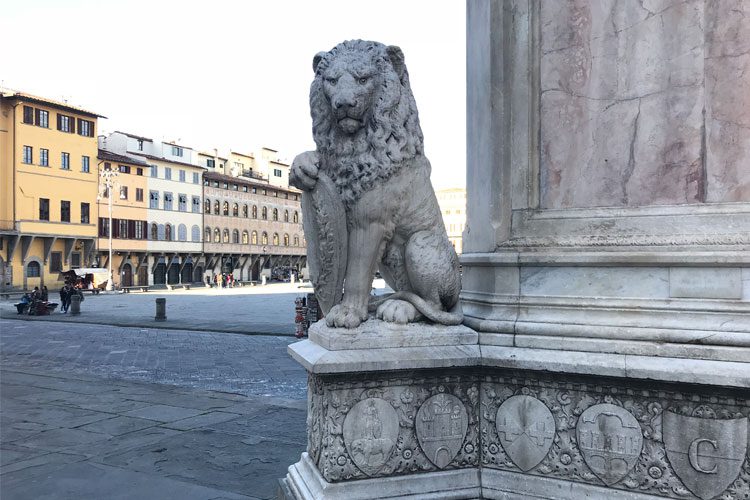
Another spotting of the Marzocco lion is located at Piazza Santa Croce at the Statue of Dante. The Statue of Dante was created in 1865 to celebrate the poet’s 600th birthday. Four heraldic lions stand at each corner of the pedestal holding shields with the names of Dante’s works. With many more statues of the Marzocco lion, it is clear that this animal has such an important historic connection.
See more of Florence and Italy at FUA’s FB, Instagram, and Twitter.