By Monica Humphries
When you step out of your apartment for the very first time, it’s a whirlwind of emotions. You feel enthralled to be in a new place. You feel excited for what the semester has to offer. You feel anxious, confused and eager.
I felt nervous.
Yes there were positive emotions, but buried not-so-deep were my nerves. I was in a foreign country, and the car ride to my apartment left me feeling like I was on the other side of the world.
I can vividly remember our driver taking all 7 students to their apartments. The first one was dropped off right past the Duomo, the second two near the San Lorenzo, a few more in the city center. Then there was me. I could remember crossing a river, going up and down the one-way streets, and finally pulling into a narrow, bike-filled lane right up to apartment number nine. After what must have been a half hour, I was home, but I wasn’t happy.
Although I was just on the other side of the river, I felt like there was a wall dividing me from all of my classmates. I stepped out onto the cobblestone street and immediately was lost. I stumbled my way through the streets until I found the Arno.
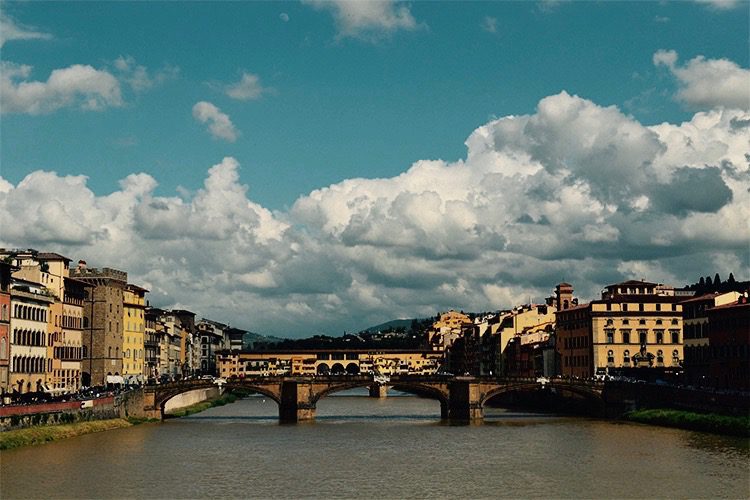
Since that first afternoon, the Arno, more specifically the Ponte alla Carraia, which is the bridge that leads to my street, has become my favorite place in Florence.
No matter where I was coming from – class, dinner or a cappuccino, all I had to do was find the river, and I knew exactly where I was. Since moving to Florence, the river is not only beautiful, but it has also become my safety net. A safety net that encourages me to explore and challenge my surroundings.
Curious about the Arno’s history and bridges, I talked to Giulio Vinci, a professor at FUA.
Vinci started at the very beginning. Florence was founded and controlled by the Romans. Romans generally build their cities in the valleys, so Florence followed this tradition and was built in a valley close to the river.
The city was structured in a rectangular shape with two central roads crossing through the city. The city was close to the water, but Florence wasn’t directly on the water, so there wasn’t travel between the sides of the river. Florence began expanding, and the Ponte Vecchio was the first bridge across the Arno. The first occurrence of the bridge was in a painting in 996.
The Ponte alla Carraia bridge is the second oldest bridge in Florence and known for its history of collapsing. Built in 1218 by architect Lapo, it collapsed for the first time in 1274 because of a flood. The bridge was originally built in wood, but it was rebuilt in stone. However, the stone was strong enough to support a crowd and collapsed again. In 1333 another flood struck Florence, and the bridge was once again destroyed. The most recent collapse was during WWII when it was bombed to prevent passage of allied troops from the Nazis in retreat.
Vinci said that tourism has exponentially grown in the past 20 years, and now Florence is a key location for visitors. He made a point to express that the river and its bridges always attract tourists. Florence is known for its concentration of art, and the bridges are a part of that art. But not everyone, unfortunately, is interested in the art and history behind the bridges, and many prefer to simply use the bridges are picture spots. We’ve lost the meaning of tourism, and traveling today is vastly different from the young aristocrats of the 18th century who often went on year-long Grand Tour to discover the culture of European cities.
Thinking about what Vinci shared helped me appreciate my time here. Sometimes three months seems like forever, but with a city that has enough history for a lifetime, I’m thankful that I will have a chance to immerse myself and retain the details I learn about this city.
Walking home from the interview gave me a chance to reflect on my time here. Although it’s only been a month, I can now continue to expand my safety net to the entire city of Florence.
The bridge is a place of comfort but it’s now a place of curiosity. Each time I walk across the bridge I notice a new detail. I question the statue at the entrance, the crack along the pavement and the windows in the Ponte Vecchio. The comfort I have now encourages me to explore. It’s important that every student finds their Ponte alla Carraia. Whether it’s the San Lorenzo church or carousel in Piazza della Repubblica, we need a monument or location where we feel at home. But part of home is knowing its history and why it’s there. Yes, the pictures we take are important, but the history behind those photographs enrich our experience so much more. Take a second, learn about the area you call home, because you might end up loving the city just a little bit more.
I find comfort in the bridge because that’s where I find confidence. Confidence with directions, confidence in knowing there’s the best gelato place right around the corner, confidence that there will be a beautiful sunrise in the morning and an even prettier sunset at night. Learn about the landmark you call home, and you might end up finding a little confidence in a city full of new experiences.
See more of Florence and Italy at FUA’s FB, Instagram, and Twitter.